HRMS software for
companies in Dubai.
One HR and payroll system for a Dubai workforce, whether your people work for a mainland company, a free-zone company or a DIFC firm: WPS files per trade licence, gratuity or DEWS, visa steps, medical cover and payslips in English or Arabic.
What it does for Dubai employers
- MOHRE WPS SIF Files
- Gratuity Under Decree-Law 33
- DIFC DEWS Contributions
- Visa Steps and Expiry
- Medical Cover Tracking
- GPSSA for Emiratis
- Ramadan Hours
- Arabic Payslips
Three sets of rules in one city.
Where a company is licensed decides which law its people work under, who issues their permits and what they are owed when they leave.
| Mainland | Free zones such as JAFZA, DMCC and DAFZA | DIFC | |
|---|---|---|---|
| Employment law | Federal Decree-Law No. 33 of 2021 | Federal Decree-Law No. 33 of 2021 | DIFC Employment Law No. 2 of 2019 |
| Work permit | MOHRE | The free zone authority | The DIFC Authority |
| Residence visa | GDRFA Dubai | GDRFA Dubai | GDRFA Dubai |
| Wage protection | MOHRE WPS, due by the 1st of the next month | Set by each zone; check what yours requires | Outside MOHRE WPS; pay due within 7 days of each pay period |
| End of service | Gratuity: 21 days of basic a year for five years, then 30, capped at two years' wage | The same gratuity as the mainland | DEWS contributions of 5.83% or 8.33% of basic since 1 February 2020; gratuity only for service before |
| Annual leave | 30 calendar days a year | 30 calendar days a year | 20 working days a year |
| Health insurance | Employer insures every employee and cannot deduct the cost from pay | The same Dubai rule | The same Dubai rule |
Employing people in Dubai, briefly.
Mainland or free zone is the first question
Most of Dubai runs on the federal labour law. A mainland company and a company in JAFZA, DMCC or Dubai Silicon Oasis apply the same Decree-Law: the same notice periods, the same thirty days of leave, the same gratuity. What changes is the paperwork. A mainland company gets its work permits from MOHRE; a free-zone company gets them from its zone. Either way the residence visa is issued by GDRFA Dubai, and since March 2024 Dubai's Work Bundle lets the permit, the visa and the Emirates ID run as one application.
The difference shows up on the payroll side. Mainland companies pay through MOHRE's Wage Protection System. Free zones each decide whether their companies must, so the answer for a company in one zone is not the answer for its neighbour in another.
DIFC is a separate system
The Dubai International Financial Centre has its own Employment Law, and the biggest difference is at the end of employment. Since 1 February 2020 a DIFC employer pays monthly contributions into a qualifying savings scheme, usually DEWS, instead of building up gratuity: 5.83 per cent of basic pay for the first five years of service and 8.33 per cent after that. Gratuity is still owed for service before February 2020, and for both calculations basic pay is treated as at least half of the total wage.
UAE and GCC nationals in DIFC are registered with the pension authority instead, and leave is counted in working days: 20 a year, with sixty days of sick leave in a year on a falling scale of pay.
Health cover is the employer's bill
Under Dubai Law No. 11 of 2013 every employer in Dubai has to insure its employees, and cannot recover the premium from their salary. Cover for an employee's family is the responsibility of whoever sponsors them, which is usually the employee. A lapsed policy tends to surface at the worst moment, when a visa is renewed, so the expiry date belongs next to the visa's.
Salaries are due on the 1st
Since 1 June 2026 a month's wages have to be paid by the first day of the next month. The old fifteen-day window has gone, and the consequences of paying late start within days: alerts from the second day, then a block on new work permits from the fifth. For a Dubai company hiring steadily that block costs more than any fine.
What DenwaysHR does in Dubai.
The parts of the work above that a system can do, done from the employee record rather than from a spreadsheet beside it.
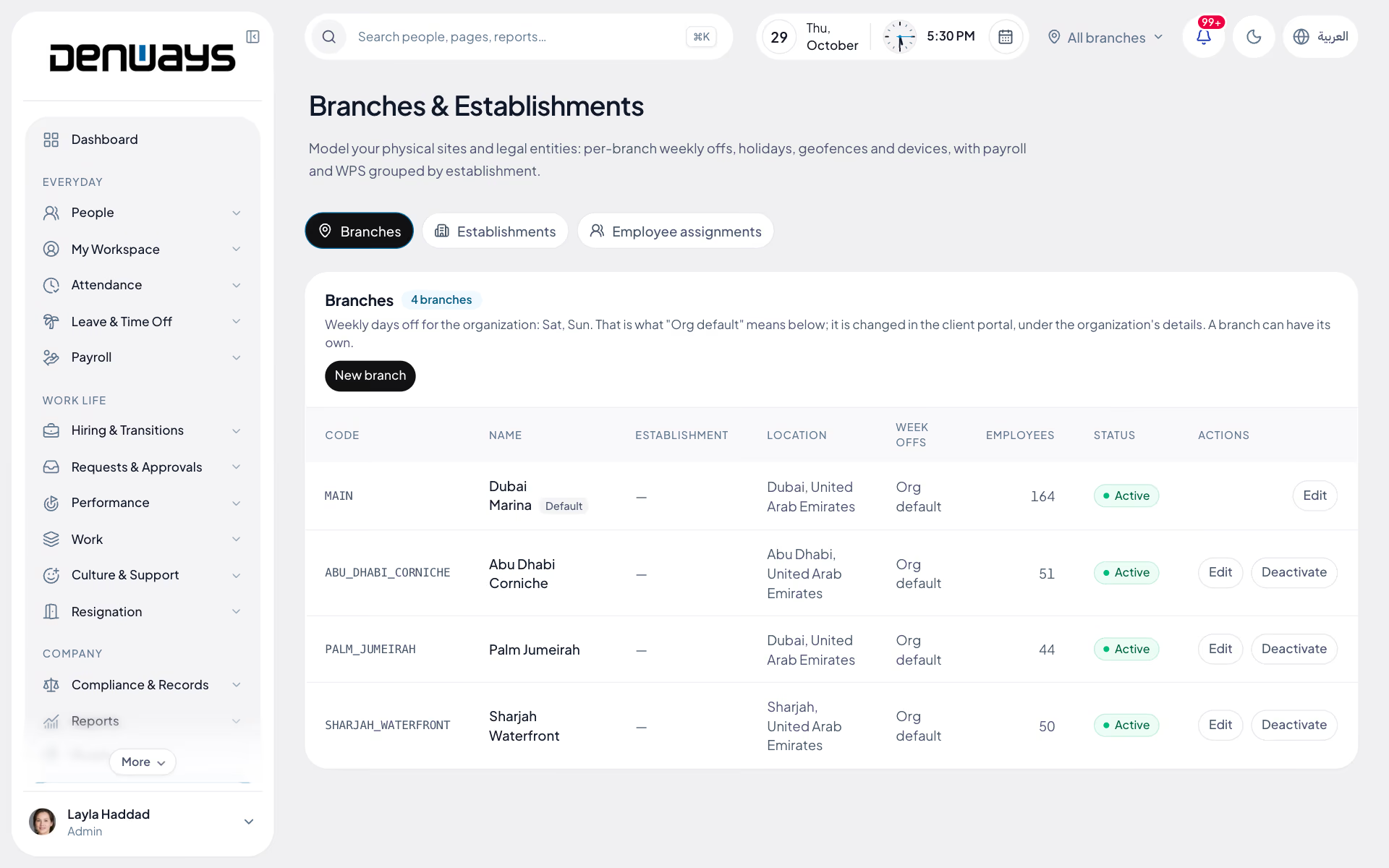
One Dubai trade licence, one WPS file
Each establishment in the account carries its own WPS employer ID, MOHRE establishment ID and bank routing code, and the salary file is built from the approved payroll run for that establishment alone.
- SIF file generated from the approved run, with nothing re-keyed
- A run that mixes two establishments is refused before a file is built
- Missing IBANs and MOHRE person codes named before the file goes out
- Each payment recorded once the upload is confirmed
DEWS for DIFC firms, gratuity for everyone else
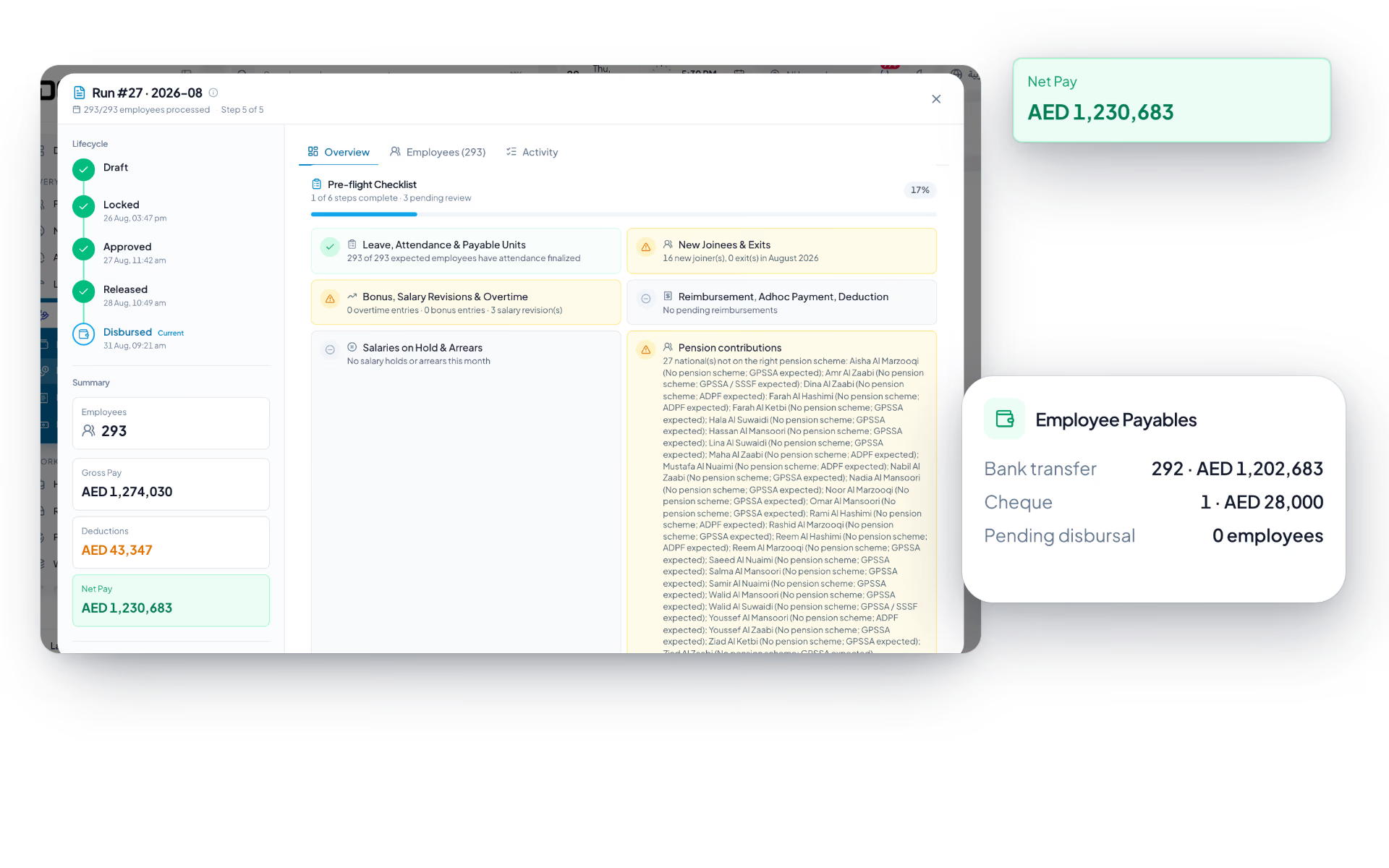
Mark an establishment as DIFC with its DEWS start date and payroll works out each month's contribution from basic pay and length of service for the people working there. Their gratuity stops building from that date, and a final settlement pays only for service outside the scheme.
- 5.83% of basic under five years of service, 8.33% from five years
- A DEWS line on every payslip
- A monthly contribution schedule to send to the scheme
- Rates you can edit, if your scheme administrator confirms different ones
Visas and medical cover, dated and chased
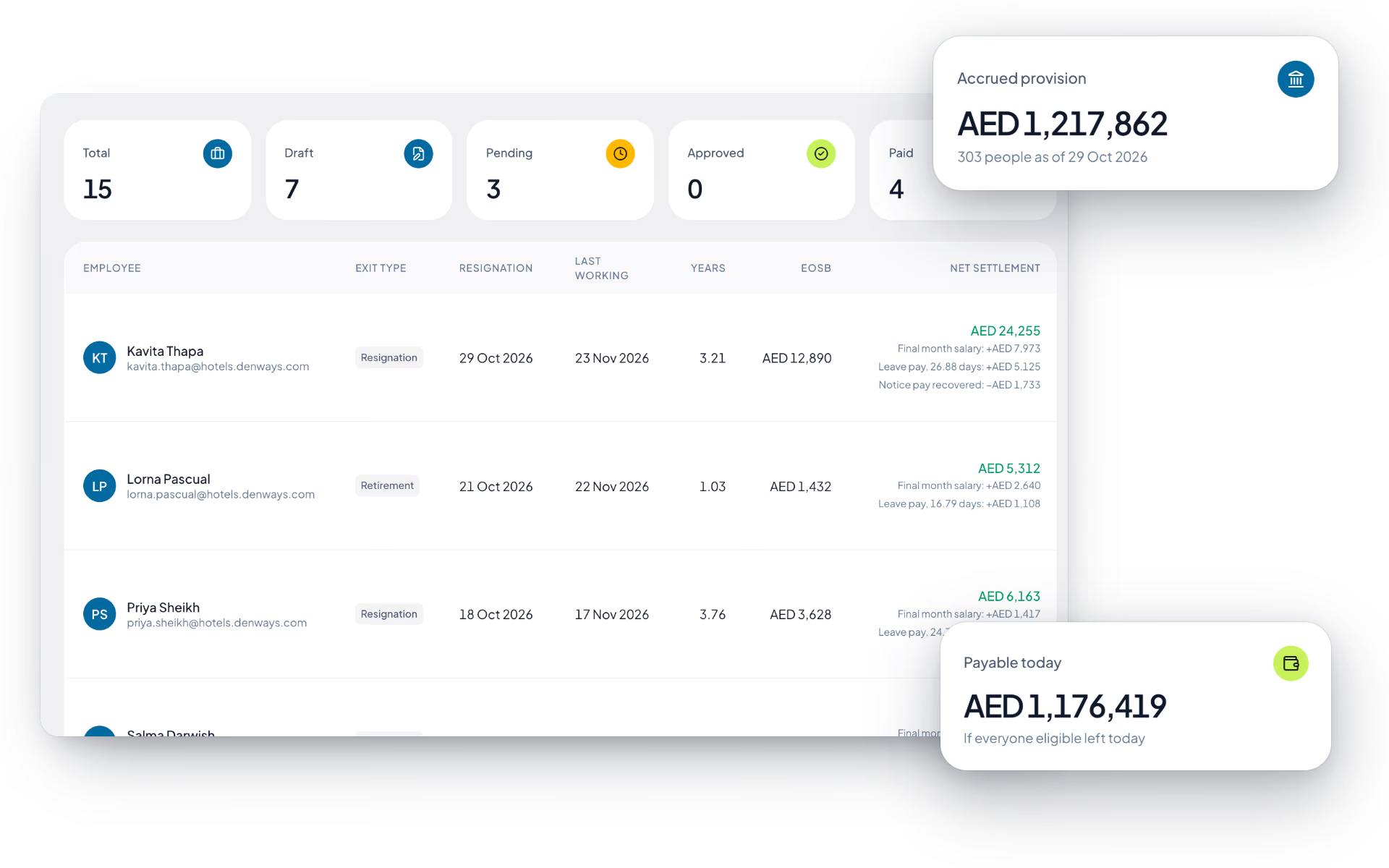
A visa is tracked as the steps it really takes, each with its reference number and date, and the expiry dates it produces land on the employee's record next to their medical cover.
- New visas, renewals and cancellations, step by step
- Insurer, policy, plan, cover dates and dependants covered for each employee
- Alerts at 90, 60, 30 and 7 days before anything expires, then reminders
- Emirates ID, labour card and passport held encrypted
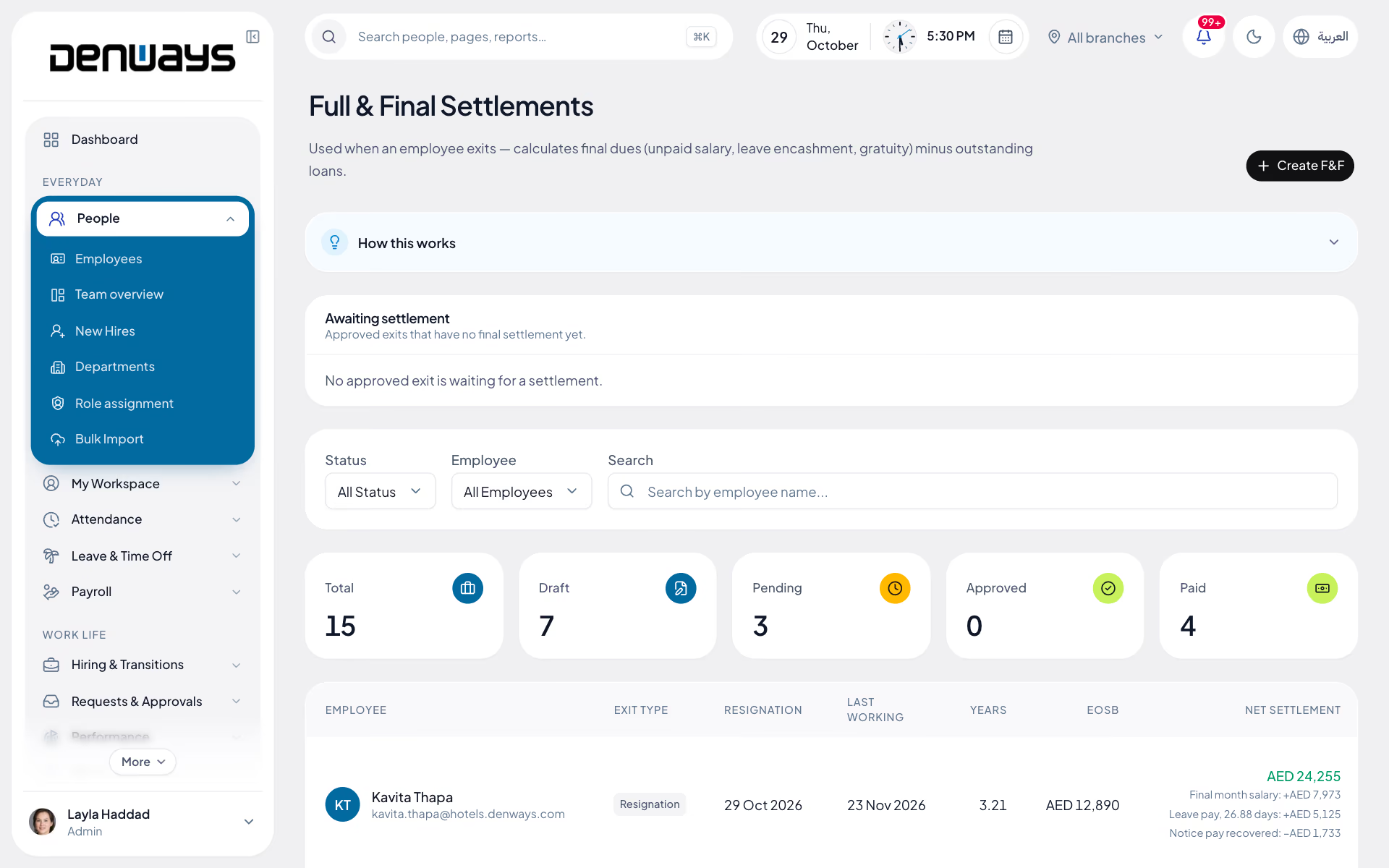
A Dubai final settlement inside the 14 days
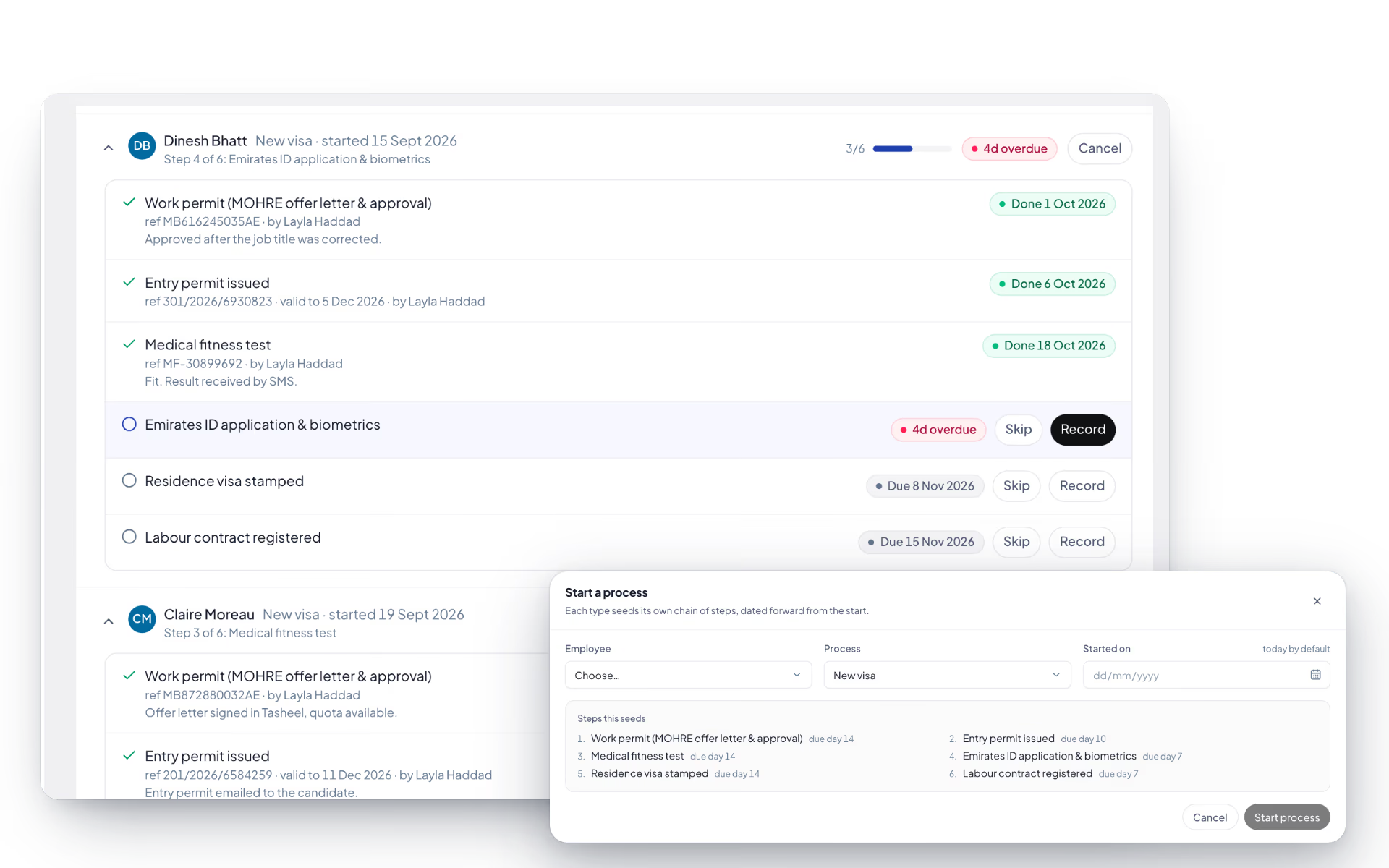
When someone leaves, the settlement is worked out line by line from the record: final salary, untaken leave on basic pay, gratuity, notice pay and anything owed back to the company.
- Gratuity at 21 days of basic for each of the first five years and 30 after, capped at two years
- Loan, advance and unreturned-asset recoveries shown as their own lines
- A signable settlement statement in English, Arabic or both
- Paid through its own WPS file once approved
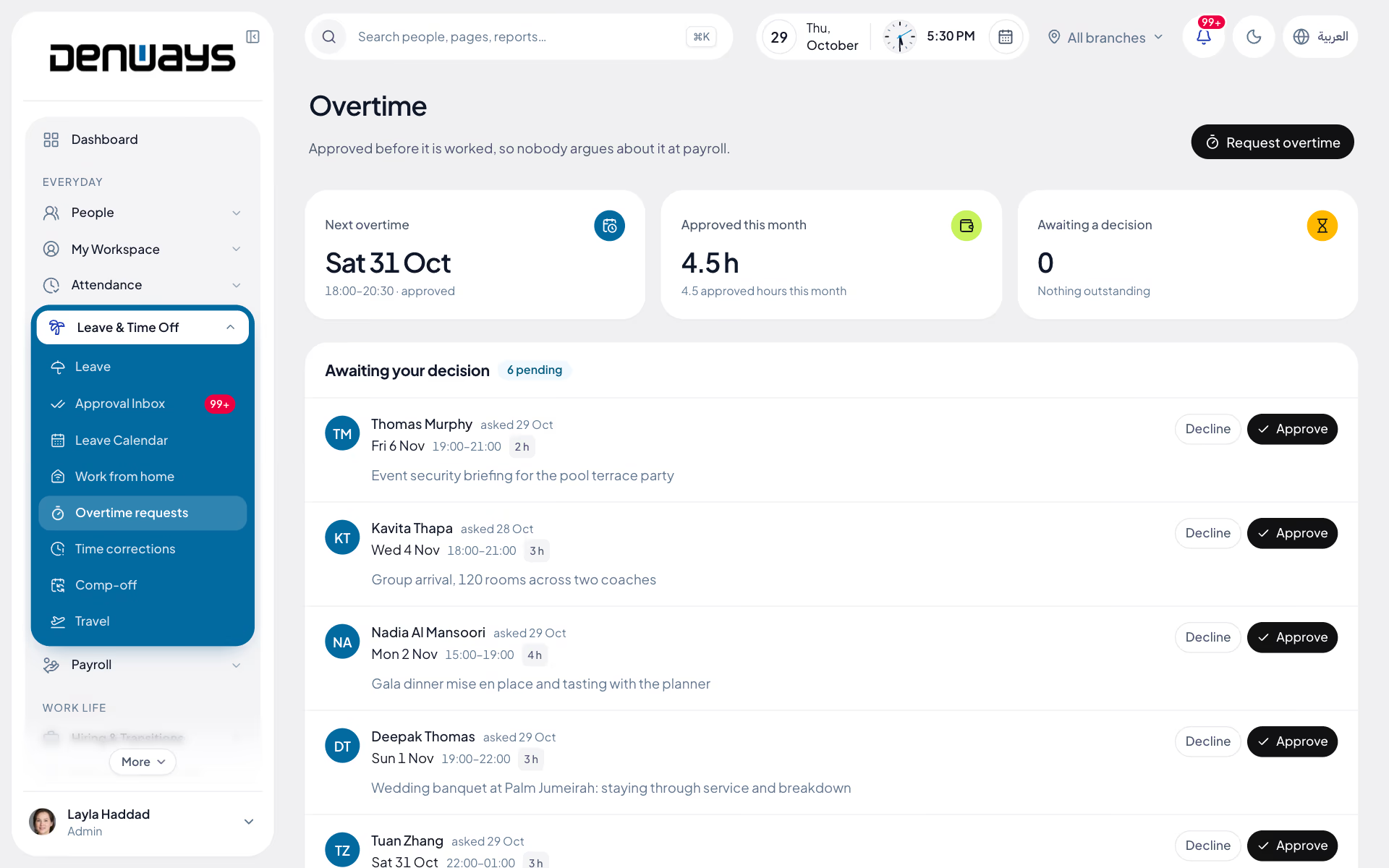
Overtime and Ramadan hours, at the statutory rates
Approved overtime is priced from basic pay at the rates the law sets as a floor, and a dated Ramadan rule takes two hours off the working day for the people it covers.
- 1.25 times the hourly rate, and 1.5 times between 10 pm and 4 am
- 1.5 times for hours worked on a rest day or a public holiday
- Your own overtime rule wins wherever it pays more, with daily and monthly caps
- Ramadan rules shorten the day's target and start overtime earlier
Where DenwaysHR stops in Dubai.
What is built in for a Dubai team, and what stays outside the product.
Built in
- WPS salary files per establishment
- Gratuity, DEWS and GPSSA lines on the payslip
- Expiry alerts for visas, IDs and medical cover
Set up by you
- DIFC leave of 20 working days, as its own leave type
- Eid and other moon-sighted holidays, as they are announced
- Overtime rules that pay above the legal floor
Not built
- Leave rules that change by themselves with an establishment's zone
- Filing with GDRFA, MOHRE or the insurer: your PRO still submits
Questions
Dubai questions, answered.
Does DenwaysHR work for DIFC companies?
Yes. Mark an establishment as DIFC with its DEWS start date, and payroll works out the monthly contribution at 5.83 or 8.33 per cent of basic pay by length of service, prints it on the payslip and builds a monthly schedule for the scheme. DEWS is set per DIFC establishment, so one account can hold a DIFC firm beside a mainland company: mainland staff stay on gratuity, and someone who moves between the two has gratuity for the mainland days and DEWS for the DIFC days.
Can one account cover a mainland company and a free-zone company?
Yes. Each establishment keeps its own WPS employer ID, MOHRE establishment ID and bank routing code, and every WPS file covers one establishment only. Branches can have their own weekend and holiday calendar. Both companies follow the same federal labour law, so the rest of the rules are shared.
Does it apply for visas with GDRFA?
No. It tracks each visa as the steps it takes, with reference numbers, dates and the expiry dates that result, and reminds HR and the employee before anything lapses. The applications themselves are still submitted by your PRO or typing centre.
Is employee health insurance tracked?
Yes. Each employee's insurer, policy number, plan, cover dates and the number of dependants covered sit on their record, and the daily compliance scan warns at 90, 60, 30 and 7 days before a policy ends.
When do salaries have to be paid now?
By the first day of the following month. Ministerial Resolution No. 340 of 2026 took effect on 1 June 2026 and removed the old fifteen-day grace period. The UAE Government portal says employers must transfer at least 85 per cent of the total wages due on time through the Wage Protection System.
Can payslips be issued in Arabic?
Yes. Payslips and settlement statements can be printed in English, in Arabic laid out right to left, in both, or in each employee's own language, and the web app itself has a full Arabic interface.
Sources
- UAE Government portal: Federal Decree-Law No. 33 of 2021, English text (PDF, not an official translation)
- UAE Government portal: Payment of salaries and wages
- UAE Government portal: Getting a health insurance
- Dubai Legal Portal: Law No. 11 of 2013 on health insurance
- DIFC Authority: Employment Law, DIFC Law No. 2 of 2019 (PDF)
Official pages, read on 2 November 2026. The law is the authority; check it, or ask your adviser, before acting on a figure.
Dubai reading
Elsewhere in the UAE
Bring your whole workforce onto one platform.
See how DenwaysHR handles HR, attendance and leave across the GCC, and payroll with the WPS file in the UAE.