UAE salary structure: Same package,
very different entitlements.
UAE law sets no minimum percentage for basic salary; the registered contract does. Why the split decides gratuity, leave pay and overtime, and deduction limits.
The short answer
UAE federal law does not fix how much of a salary must be basic; the contract registered with MOHRE sets it. The split matters because end-of-service gratuity, overtime and leave paid on exit are all worked out on basic salary alone. Two employees on AED 12,000 a month can be owed AED 18,000 or AED 32,400 in gratuity after six years.
Two people on the same total salary can be owed very different amounts when they leave, because almost every statutory payment in the UAE is worked out on basic salary alone. How a package is split is the most consequential line in the contract.
What percentage of a UAE salary has to be basic?
None is set. Federal Decree-Law No. 33 of 2021 names no minimum percentage for basic salary. What it does set is the meaning: Article 1 defines the basic wage as the wage in the contract without allowances or benefits in kind, and Article 22 leaves the amount to the contract.
If someone quotes a fixed percentage as the law on the mainland, ask for the article.
A UAE pay package is normally written as a basic salary plus allowances: housing, transport, sometimes telephone, food or a general allowance. The federal law does not say what share must be basic. That is a decision for the contract, and once the contract is registered with the ministry it is the figure every statutory calculation starts from.
The two financial free zones are the exception. DIFC and ADGM both treat basic pay as at least half of the total wage when working out end-of-service pay, whatever the contract says, so a low basic does not lower what is owed there.
Which payments are worked out on basic salary?
| Payment | Worked out on |
|---|---|
| End-of-service gratuity | Last basic salary |
| Untaken leave paid on exit | Basic salary |
| Overtime | Basic salary |
| Public holiday worked | The day's wage plus at least 50% of basic |
| Notice pay | Full wage, with allowances |
| ILOE category | Basic salary, above or below AED 16,000 |
| Savings Scheme contribution, if the employer has joined | 5.83% or 8.33% of monthly basic |
Take two employees on AED 12,000 a month who both leave after six years. One has a basic of AED 4,000, the other AED 7,200. Each has earned 135 days of gratuity. For the first that is AED 18,000; for the second, AED 32,400. Nothing else about their jobs needs to differ.
The split also sets the cost of MOHRE's Savings Scheme, the voluntary alternative to gratuity. An employer that joins pays 5.83 per cent of monthly basic for an employee with under five years' service and 8.33 per cent after that, into an approved fund within the first 15 days of each month. Gratuity already earned has to be worked out and settled at enrolment, so the basic on that day matters twice.
A low basic is a deferred argument
Setting basic low keeps gratuity, leave encashment and overtime cheap. It also makes every exit a negotiation, and it shows in a dispute. A split that holds up is one the company could explain to the ministry without embarrassment.
Split a package into basic and allowances and see what each split does to gratuity.
Open the salary calculatorCan an employer change the split between basic and allowances?
Moving money between basic and allowances is a change to the contract. It needs the employee's written agreement and an updated contract with the ministry. Reducing basic to cut future gratuity, without the employee's consent, is the kind of change that is unpicked in a claim.
When, and in what currency, must wages be paid?
- Wages are paid in dirhams unless the contract names another currency
- Since 1 June 2026 a month's wages are due by the 1st of the following month, through the Wage Protection System
- Since 1 January 2026 an Emirati in the private sector must be paid at least AED 6,000 a month
- For work to count as skilled, the portal needs a monthly salary of at least AED 4,000, leaving out commission
What can an employer deduct from wages?
Article 25 lists the deductions an employer can make from wages and caps each one. Together they cannot take more than half of the wage.
| Deduction | Limit |
|---|---|
| Recovering an overpayment | 20% of the wage |
| A disciplinary penalty | 5% of the wage |
| Damage the employee caused | 5 days' wage a month |
| A loan or advance | Only with written agreement, and no interest |
| A court-ordered debt | 25% of the wage, except maintenance |
| All deductions together | 50% of the wage |
What should a payslip show?
What has to match on the mainland is the wage paid through the Wage Protection System and the wage in the contract. A payslip that shows how the figure was reached, line by line, is how a company proves that it did. DIFC goes further and requires an itemised statement of pay for every period.
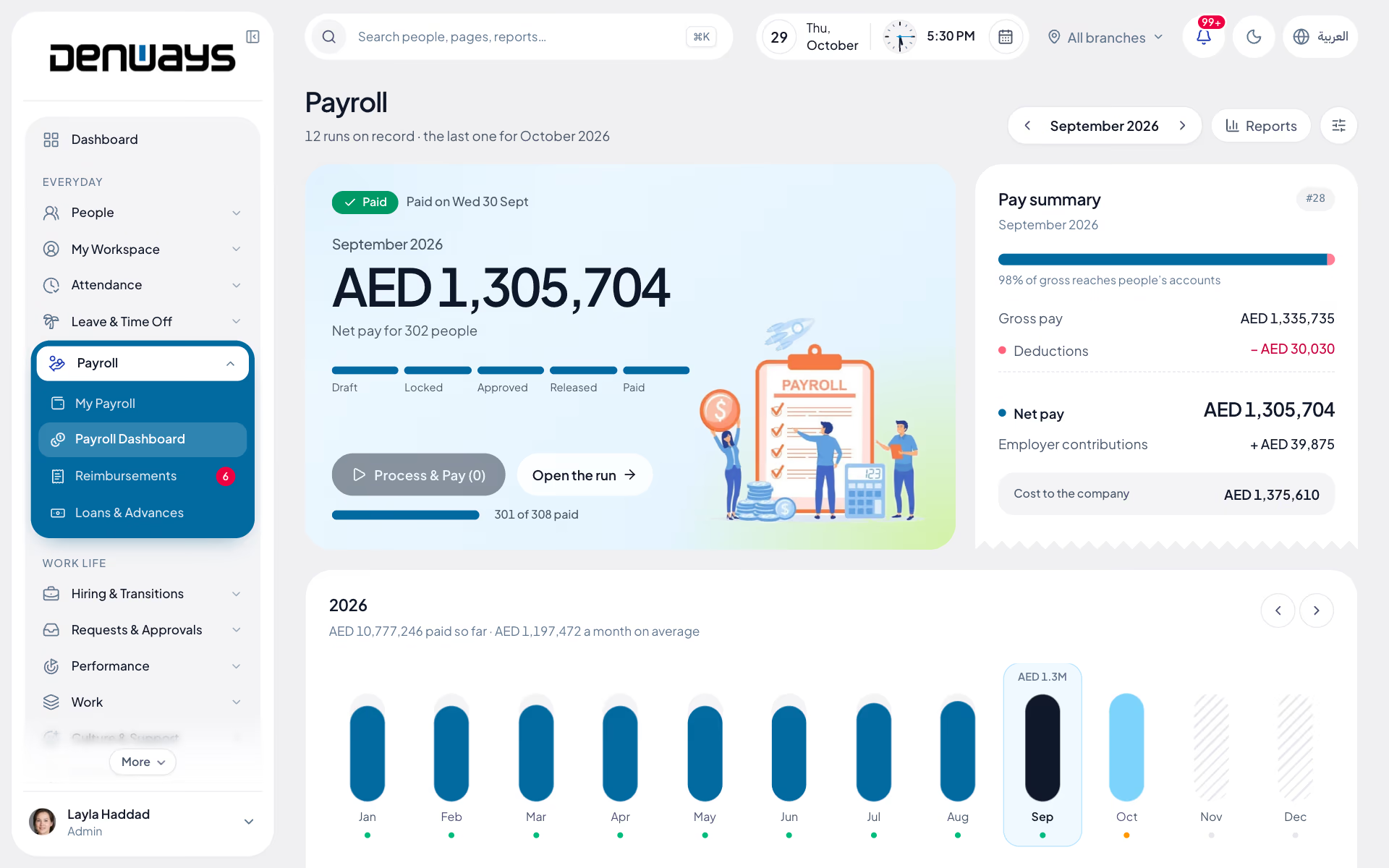
DenwaysHR holds basic, housing, transport and other allowances on each salary, and works out gratuity, leave encashment and overtime from basic only.
See UAE payroll and WPSSources
- UAE Government portal: Payment of salaries and wages (Wage Protection System, Ministerial Resolution No. 340 of 2026)
- UAE Government portal: End-of-service benefits for employees in the private sector
- UAE Government portal: Federal Decree-Law No. 33 of 2021, English text (PDF, not an official translation)
Official pages, as they stood on the date above. The law is the authority; check it, or ask your adviser, before acting on a figure.
Keep reading
Bring your whole workforce onto one platform.
See how DenwaysHR handles HR, attendance and leave across the GCC, and payroll with the WPS file in the UAE.