UAE onboarding: Onboarding,
from offer letter to first payslip.
From offer and contract to entry permit, medical, Emirates ID, labour card, bank account and day-one setup, with the documents to keep and a first-90-days plan.
The short answer
Onboarding in the UAE is two processes at once: immigration, which a PRO or the free zone handles through the work permit, entry, medical, biometrics, residence visa and Emirates ID, and employment, which HR controls. Settle the basic-and-allowances split in the offer, create the employee record before day one, sort the salary account early because wages go through WPS, and track probation as a date.
Onboarding in the UAE is two projects running at once: an immigration process you mostly cannot control, and an employment process you entirely can. This is how to run both without one blocking the other.
What comes first: the offer or the contract?
Onboarding starts with a written offer that matches the contract that will follow it. In the UAE the salary structure set at this point has consequences for years, because the split between basic salary and allowances drives the overtime rate and the end-of-service gratuity calculation, both of which are computed on basic.
Decide the split deliberately rather than copying the last offer. A package with basic set at forty per cent and one with basic at sixty per cent look identical to the employee each month and produce very different liabilities at exit.
The employment contract is registered with the relevant authority, and the registered terms are what count. Make sure the offer, the registered contract and the payroll record agree on job title, salary components, working hours and start date before anyone signs anything.
On the mainland the process runs through a standard job offer that the employee signs before the contract is issued, and the contract is expected to reflect it. Where the two differ, you are creating a dispute in advance, so any negotiation should be settled before the offer is submitted rather than patched afterwards.
The start date is not always the joining date
Immigration timelines slip, and a contract start date that has already passed while the employee is still overseas creates awkward questions about pay and service. Agree what happens if the permit is delayed, in writing, before the offer goes out.
Does onboarding differ between the mainland and a free zone?
Where the employing entity is licensed determines who processes the employment. A mainland company sponsors employees through the Ministry of Human Resources and Emiratisation together with the immigration authority in the relevant emirate. A free zone company sponsors through the free zone authority, which handles much of the paperwork itself.
The employee's experience is broadly similar either way: a permit, a medical, biometrics, a residence visa and an Emirates ID. What differs is who you deal with, which portal the records live in, the fee schedule and the contract template. Some financial free zones apply their own employment law entirely, which changes the substantive rules and not only the process.
If your business holds licences in more than one jurisdiction, treat them as separate entities from the start. Employees belong to one entity, records are kept per entity, and a transfer between them is a real process rather than a change of department.
The practical difference for HR is who you chase. In a free zone the authority is usually a single counterparty handling permit, visa and card together, and its service standards are its own. On the mainland the steps sit across more than one authority, which is why mainland onboarding benefits most from a PRO who does it every week.
What are the steps from entry permit to residence visa?
The immigration sequence is handled by the employer's PRO or through a typing centre, and this guide describes it only at a level that helps HR plan.
Every step below has conditions, fees and exceptions that depend on the emirate, the free zone, the employee's nationality and their current status, and immigration advice should come from your PRO or a licensed adviser.
In broad terms: a work permit and entry permit are issued, the employee enters the country or has their status adjusted if already resident, they complete a medical fitness test and biometrics, the residence visa is stamped or issued electronically, and the Emirates ID is produced. The labour card or its equivalent formalises the employment relationship with the labour authority.
| Stage | Handled by | Typical wait |
|---|---|---|
| Work and entry permit | PRO or free zone | Days to weeks |
| Entry or status change | PRO | Days |
| Medical fitness test | Employee, booked by PRO | Days |
| Biometrics for Emirates ID | Employee | Days |
| Residence visa issued | Immigration authority | Days to weeks |
| Emirates ID delivered | ICP | Weeks |
| Labour card issued | MOHRE or free zone | After visa |
Plan around the wait, do not promise a date
The one thing you can say confidently to a new joiner is what the steps are and who is doing them. Committing to a specific completion date is how HR ends up apologising for something outside its control.
Medical fitness and biometrics
The medical fitness test is a condition of residence and is done at an approved centre. Biometrics are captured for the Emirates ID. Both are appointments the employee attends personally, so they need clear instructions, the location, what to bring and whether the appointment is already booked.
Why does the first salary depend on the bank account?
Salaries must be paid through approved channels under the Wage Protection System, which means a new employee cannot be paid normally until they can receive money through one. In practice most banks want the Emirates ID before opening a full account, which is why a first salary sometimes falls due before the account exists.
Deal with this deliberately rather than improvising on payroll day. Options commonly used include payroll cards or approved exchange house arrangements while the account is being opened. Whichever route you take, the payment still has to be reportable, and the employee's identifiers on the payroll record must match the ones on the file.
Collect the account details on a form, verify the IBAN against the bank letter rather than a screenshot, and store it on the employee record. A transposed digit in an IBAN produces a returned transfer, and a returned transfer produces a wage protection mismatch.
Which documents should HR collect and keep?
Collect documents once, store them in one place against the employee record, and record their expiry dates as data rather than as a note. Expiry tracking is the whole point: a passport, visa or Emirates ID that lapses unnoticed becomes an operational problem and, in some cases, a compliance one.
- Passport copy, with expiry recorded
- Visa and Emirates ID, with expiry recorded
- Signed offer and registered employment contract
- Educational and professional certificates where the role requires them
- Attested documents where attestation is required for the role or licence
- Bank letter or IBAN confirmation
- Emergency contact and next-of-kin details
- Medical insurance enrolment confirmation
Health insurance is mandatory in several emirates and the rules differ between them, so confirm the requirement for the emirate the employee works in and enrol them within the required window. Dependants may need separate arrangements.
Take copies, and return originals. An employer holding an employee's passport is not an administrative convenience, it is a position you do not want to be defending, and there is no process that requires you to keep one on file permanently. Record what you hold, when you took it and when you gave it back.
What should happen on day one and in the first week?
Day one has one job: make the person productive and correctly recorded. That means the employee record exists in the HR system before they arrive, not after, with their start date, entity, department, manager, salary structure and leave policy already set.
- Employee record created with the correct entity and start date
- Attendance enrolment: biometric, mobile or geofenced site check-in
- Shift or roster assigned so attendance does not flag from day one
- Leave policy and public holiday calendar attached
- Assets issued and signed for: laptop, phone, SIM, tools, uniform, access card
- System access provisioned, and access to nothing they should not have
- Payroll record complete: bank details, salary components, effective date
- Policies acknowledged, including conduct, leave and expenses
Asset handover deserves a signature. It is trivial at issue and impossible to reconstruct at exit, and the difference shows up in the final settlement when nobody can say whether the laptop was ever returned.
How should probation and the first 90 days be managed?
Probation gives both sides shorter terms for ending the employment, and it has specific notice rules including where an employee leaves to join another UAE employer. The rules are rarely the problem. The tracking is: probation periods that lapse unnoticed confirm the employee by default and remove the flexibility the employer assumed it had.
Set the probation end date as a dated field with a reminder that reaches the line manager well before it, not on the day. A decision made a week early is a decision; one made a week late is an administrative accident.
| Checkpoint | What happens |
|---|---|
| Week 1 | Setup complete, policies acknowledged |
| Week 2 | Role expectations agreed in writing |
| Day 30 | First review, documented |
| Day 60 | Progress review and any corrective plan |
| Day 75 | Confirmation decision started |
| Day 90 | Probation outcome recorded |
Close the loop on the immigration file too. By the end of the first ninety days the residence visa, Emirates ID and labour card should be issued and recorded, the bank account should be live, and the employee should be paid through the normal wage protection channel like everyone else.
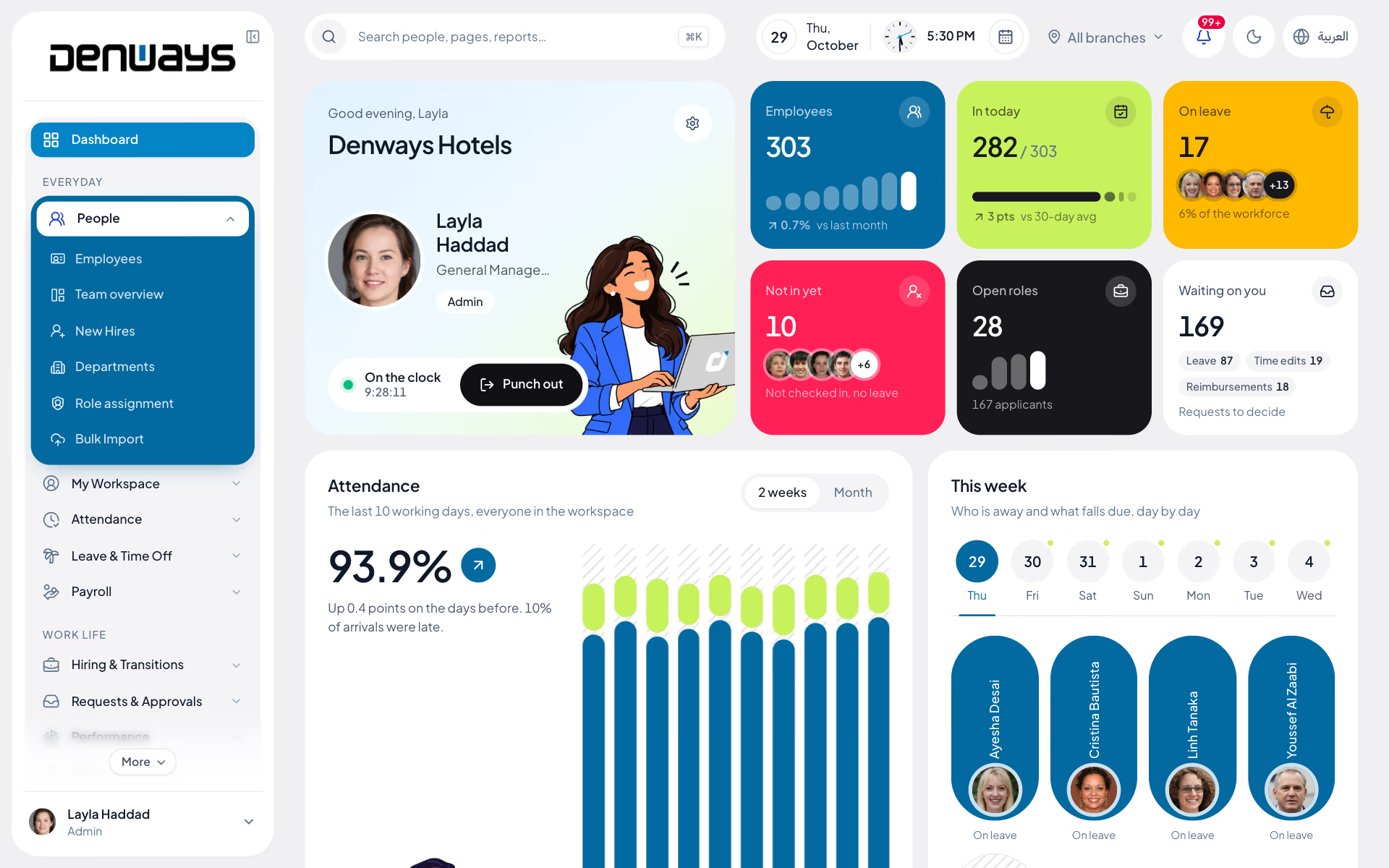
DenwaysHR keeps documents, expiry dates, assets and probation dates on one employee record.
See core HRSources
Official pages, as they stood on the date above. The law is the authority; check it, or ask your adviser, before acting on a figure.
Keep reading
Bring your whole workforce onto one platform.
See how DenwaysHR handles HR, attendance and leave across the GCC, and payroll with the WPS file in the UAE.