Final settlement in the UAE: The last payment,
line by line.
What goes into a UAE final settlement, the 14-day deadline, and how gratuity, untaken leave, notice pay and deductions are each worked out.
The short answer
A UAE final settlement is due within 14 days of the contract ending, however it ended (Article 53 of Federal Decree-Law No. 33 of 2021). It covers salary to the last day, untaken annual leave on basic salary, notice pay on the full wage where notice was not served, and gratuity of 21 days' basic pay a year for the first five years and 30 days after.
A final settlement is the one payroll a company runs for a single person, and the one most likely to end up in front of the ministry. Each line is worked out on a different salary figure, and using the wrong figure is the usual mistake.
When must a final settlement be paid?
Under Article 53 of Federal Decree-Law No. 33 of 2021 an employer has to pay an employee's wages and every other entitlement within fourteen days of the contract ending. It makes no difference who ended it or why. Resignation, termination, a fixed term running out and dismissal under Article 44 all start the same clock.
Since the 2024 amendments to the law, MOHRE decides claims of up to AED 50,000 itself, and its decision can be enforced like a judgment, with an appeal to the Court of First Instance. An employee has two years from the end of employment to bring a claim. A settlement that is late or short is therefore not a matter that fades; it is one that comes back with a ministry reference number.
What goes into a final settlement?
A final settlement is a set of separate lines, each worked out on its own basis.
| Line | Worked out on | What decides it |
|---|---|---|
| Salary to the last day | Full monthly wage | Days worked in the final month |
| Untaken annual leave | Basic salary | Every accrued day not taken, plus the share of the final year |
| Notice pay | Full wage, with allowances | Owed by whichever side did not serve the notice |
| Gratuity | Last basic salary | Years of continuous service, at 21 or 30 days a year, capped at two years' wage |
| Overtime not yet paid | Basic salary | Approved hours at the statutory or contractual rate |
| Return ticket | Cost of travel | Owed to the place of recruitment, unless the employee has joined another employer or caused the termination |
| Deductions | Amounts owed to the company | Only what the law allows, such as agreed loans and amounts due by law or judgment |
Three lines, three salary figures
Untaken leave and gratuity are paid on basic salary. Notice pay is paid on the full wage, allowances included. Salary to the last day is the full wage as well. A settlement that uses one figure for everything is wrong in one direction or the other.
How is gratuity worked out in the settlement?
An expatriate employee with at least a year of continuous service earns gratuity: 21 days of basic salary for each of the first five years and 30 days for each year after, with part years counted in proportion once the first year is complete.
The total cannot exceed two years' wage. Days of unpaid absence are taken out of the service count, and part-time employees earn it in proportion to their hours.
As an example, an employee leaves after six years and three months on a basic salary of AED 9,000. A day of basic is AED 300. The first five years earn 105 days, and the remaining one year and three months earn 37.5 days, so 142.5 days in all, or AED 42,750.
The resignation scale is gone
Under the old law an employee who resigned with less than five years' service lost a third or two thirds of their gratuity. That rule ended when the current law took effect in February 2022. Some calculators and contracts still apply it; the law no longer does.
An employer can instead join the voluntary Savings Scheme created by Cabinet Resolution No. 96 of 2023, paying 5.83 per cent of basic salary each month for employees with under five years' service and 8.33 per cent after that. Where it does, the scheme pays out the employee's balance on leaving, also within fourteen days, and the gratuity line is replaced by it.
Work out one end-of-service figure from a start date, an end date and a basic salary.
Open the gratuity calculatorHow is untaken leave paid?
Every day of annual leave the employee has earned and not taken is paid, however many there are, together with a proportion for the part of the final year worked. The law sets the basis at basic salary.
The figure usually in dispute is not the rate but the balance: which days were taken, which were carried forward with agreement, and which were refused.
How is notice pay worked out?
If either side ends the contract without serving the notice it owes, it pays the other the wage for the days not served. The notice period is the contract's, between thirty and ninety days after probation. An employee who resigns and leaves early can owe notice pay to the employer, and that amount can be set against the settlement.
What can be deducted?
The limits on deductions in Article 25 still apply at the end. A loan or advance can be recovered if the employee agreed to it in writing, and it carries no interest.
Amounts owed to the employer under the law or a court judgment can be taken from the gratuity. Recovering the cost of damage the employee caused is limited to five days' wage a month, and all deductions together cannot take more than half of a wage.
- Outstanding loans and salary advances, with the employee's written agreement on file
- Overpaid salary, recovered within the law's limits
- The cost of damage the employee caused to company property, within the five-days'-wage limit
- Notice pay owed by an employee who left without serving notice
What happens to the work permit and visa?
The employer cancels the work permit through MOHRE, or through the Work Bundle, which joins the permit and residence steps. The cancellation then passes to GDRFA in Dubai or to ICP elsewhere, and the residence visa is cancelled.
From that date the former employee has a grace period to leave the country or change status. It is no longer a flat thirty days: it depends on the visa category, commonly sixty days for an employer-sponsored resident and up to six months for some golden and green visa holders. Overstaying costs AED 50 a day.
Cancelling the permit before the settlement is paid is common, and it does not move the fourteen-day deadline. The two run in parallel: the grace period starts from the cancellation, the payment deadline from the end of the contract.
What should be kept?
A later claim over the settlement is answered from these papers, so they belong together.
- The settlement statement with every line and its basis, signed by the employee
- Proof of payment through the Wage Protection System
- The leave record behind the untaken-days figure
- Written agreement for every loan or advance deducted
- The resignation or termination letter and the date notice was served
- The work permit and visa cancellation documents
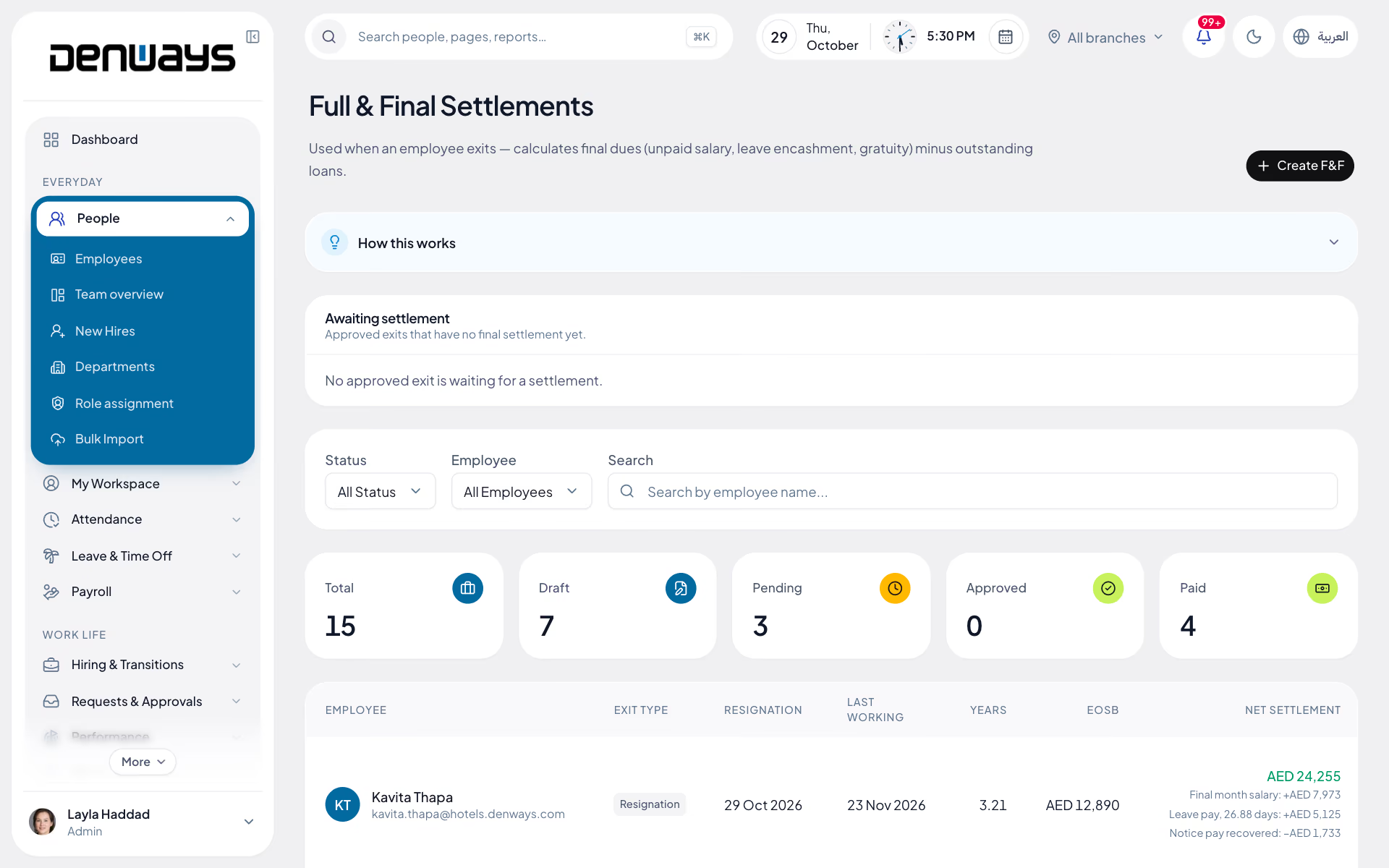
DenwaysHR builds the settlement from the employee record, each line on its own salary basis, and prints a signable statement in English, Arabic or both.
See the employee lifecycleSources
- UAE Government portal: End of service benefits for workers in the private sector
- UAE Government portal: Terminating employment contracts and arbitrary dismissal
- UAE Government portal: Payment of salaries and wages (Wage Protection System, Ministerial Resolution No. 340 of 2026)
- UAE Government portal: Employment laws and regulations in the private sector (Federal Decree-Law No. 33 of 2021)
Official pages, as they stood on the date above. The law is the authority; check it, or ask your adviser, before acting on a figure.
Keep reading
Bring your whole workforce onto one platform.
See how DenwaysHR handles HR, attendance and leave across the GCC, and payroll with the WPS file in the UAE.