Termination of employment in the UAE: Ending a contract,
from the decision to the last payment.
How a UAE employer can lawfully end a contract: the grounds, notice, dismissal without notice, what makes it unlawful, what it costs and MOHRE complaints.
The short answer
A UAE employer can end a contract for a legitimate reason on 30 to 90 days' written notice (Article 43 of Federal Decree-Law No. 33 of 2021), or without notice in the ten Article 44 cases after a written investigation. Dismissal for a valid complaint or claim is unlawful, with compensation of up to three months' wage. Final dues are payable within 14 days.
Most terminations go wrong on procedure: a missing investigation, a notice served during leave, a final payment that runs past 14 days. This takes a mainland employer through the decision and everything that follows it, with the cost worked out on a real salary.
On what grounds can a UAE employment contract end?
Article 42 lists nine ways a contract ends. Only the third is the employer's own decision, and it is the one most of this guide is about. Write the case that applies on the termination record, because the steps and the dues that follow depend on it.
| Article 42 case | What it means for the employer |
|---|---|
| 1. Both sides agree in writing | Keep the signed agreement. The employee's rights cannot be waived (Article 65) |
| 2. The term expires and is not renewed | Decide before the end date: carrying on without a renewal extends the contract |
| 3. Either side chooses to end it | Written notice under Article 43, for a legitimate reason |
| 4. The employer dies | Only where the contract is tied to the employer personally |
| 5. The employee dies or is fully and permanently unable to work | Medical certificate needed. On a death, Article 15 allows dues to go to the family within 10 days |
| 6. A final prison sentence of three months or more | Needs a final judgment |
| 7. The establishment closes permanently | Closing without settling workers' rights carries a fine of at least AED 100,000 (Article 60) |
| 8. Bankruptcy, insolvency or economic reasons that stop the business | Needs a court judgment or a decision from the authorities (Regulation, Article 25) |
| 9. The work permit cannot be renewed, for reasons outside the employer's control | Keep the evidence of why |
A slower business does not have a separate redundancy route in the articles we read. Unless case 7 or 8 applies, it uses case 3 and gives notice.
How much notice must an employer give?
Article 43 requires written notice for the period in the contract, at least 30 days and at most 90. The period has to be the same for both sides unless a difference favours the employee.
The contract stays in force until the notice ends, and the employee is paid the full last wage for that time. The rules in probation are different: an employer gives at least 14 days.
- One unpaid day off a week: where the employer gave notice, the employee can take it to look for work, after telling the employer at least three days ahead
- Notice served during leave: it starts the day after the employee's scheduled return, unless both sides agree otherwise (Article 35)
- Shorter or waived notice: allowed by agreement, while keeping the employee's rights for the notice period in the contract
- Notice not served: the side at fault pays the wage for the full period or the part left, even if the other side lost nothing
- An indefinite contract from before 2022: Article 65 sets 30 days under five years' service, 60 over five and 90 over ten
When can an employer dismiss without notice?
Article 44 has ten cases, and the probation and notice guide lists them all.
In short they are forgery or impersonation, grave loss or deliberate damage, breach of displayed safety rules, repeated failure in basic duties, disclosing work secrets, intoxication or acts against public morals at work, assault at work, unexcused absence, abuse of position and working elsewhere against the rules. Three conditions run through them.
- A written investigation with the employee comes first, in every case
- The dismissal decision is in writing, gives its reasons and is handed to the employee
- Some cases add steps: two warnings of dismissal for failing basic duties, and a report to MOHRE within seven working days for a grave loss or deliberate damage
The Executive Regulation adds a clock. A violation cannot be charged once it has been known for more than 30 days, and no penalty can follow more than 60 days after the investigation ends. Absence counts when it passes 7 days in a row or 20 separate days in a year. While investigating, an employer can suspend someone for up to 30 days on half wage, and pays the rest back if the case is closed, no violation is found or the outcome is a warning (Article 40).
Dismissal keeps the gratuity intact
Article 44 removes notice. Article 51 has no exception for dismissal, and Article 39 lists termination as a penalty that preserves end-of-service benefits. Amounts due under the law or a judgment can still be deducted under the Regulation's rules.
What makes a termination unlawful?
Article 43 asks for a legitimate reason without defining one, and Article 47 names one case as unlawful: ending the contract because the employee filed a serious complaint with MOHRE, or a claim against the employer that proves valid. Other articles block termination in particular situations, including maternity leave.
| Situation | Rule | Where |
|---|---|---|
| Complaint or claim against the employer | Unlawful, with compensation | Article 47 |
| Pregnancy or maternity leave | No termination or notice for that reason, including during the further leave after a birth | Article 30 |
| On sick leave | No dismissal or notice during it. After all 90 days, an employee who cannot return can be terminated with full dues | u.ae; Article 31 |
| Medically unfit | Not before the leave the employee is due has been used; a contrary agreement is void | Article 46 |
| Race, colour, sex, religion, national or social origin, disability | Discrimination in keeping a job is prohibited | Article 4 |
| Passport or other official documents | Cannot be withheld, and the employee cannot be forced to leave the country | Article 13 |
What does terminating an employee cost?
Take an expatriate on a wage of AED 15,000, of which AED 9,000 is basic, with six years and three months of service and 60 days' notice in the contract. The employer ends the contract and does not ask for the notice to be worked.
The employee worked 10 days of the final month and has 12 days of leave untaken.
| Line | Basis | Working | AED |
|---|---|---|---|
| Notice allowance | Last wage | 60 × 500 | 30,000 |
| Gratuity | Last basic | 142.5 days × 300 | 42,750 |
| Untaken leave | Basic | 12 × 300 | 3,600 |
| Salary to the last day | Wage | 10 × 500 | 5,000 |
| Total due | 81,350 | ||
| Compensation if found unlawful, at most | Last wage | 3 × 15,000 | 45,000 |
The compensation figure is a ceiling. A court sets the amount from the type of work, the damage and the length of service, and notice pay and gratuity stay payable alongside it. The final settlement guide goes through each line and what can be deducted. If the employer ended the contract in breach of the law, Article 10 also voids a non-compete clause.
Build the same settlement from your own figures, each line on its own salary basis.
Open the settlement calculatorHow do MOHRE complaints work after a termination?
Either side can apply, and a dispute goes to MOHRE before it can go to court. Article 54 sets the route, and it splits on the amount claimed.
| Stage | Claim up to AED 50,000 | Larger claim |
|---|---|---|
| First | MOHRE tries to settle it | MOHRE tries to settle it |
| No settlement | MOHRE decides, and the decision can be enforced | MOHRE refers it to court with a memorandum, within 14 days of the application under the Regulation |
| Challenge | Case at the Court of First Instance within 15 working days, which suspends enforcement | The court sets a hearing within 3 working days |
| Outcome | Court rules within 30 working days, and the judgment is final | The court rules promptly |
During a dispute MOHRE can make an employer keep paying wages for up to two months if the dispute has stopped them. Claims cannot be heard two years after the employment ends (Article 54). The u.ae disputes page still says one year, citing Article 10; in the current law that one-year limit sits in the non-compete clause. An employee's claim of up to AED 100,000 is free of court fees (Article 55). An employee can also leave without notice, keeping end-of-service rights, in the four cases in Article 45, one of which is an employer's unremedied breach reported to MOHRE 14 working days ahead.
What must happen after the last day?
| Task | Deadline | Where |
|---|---|---|
| Pay wages and every other entitlement | 14 days from the end of the contract | Article 53 |
| Provide a certificate of experience on request, free | When the contract ends | Article 13 |
| Pay the journey home | No day set. Not owed if the employee has joined another employer or caused the termination | Article 13 |
| Employee leaves employer housing | Within 30 days, unless agreed otherwise | Article 16 |
| Keep the employee's file | At least two years | Article 13 |
DIFC and ADGM are separate
None of this applies inside the two financial free zones. ADGM, for one, sets 7 days' minimum notice under three months' service and 30 days after that, with final pay within 21 days. See the DIFC and ADGM guide.
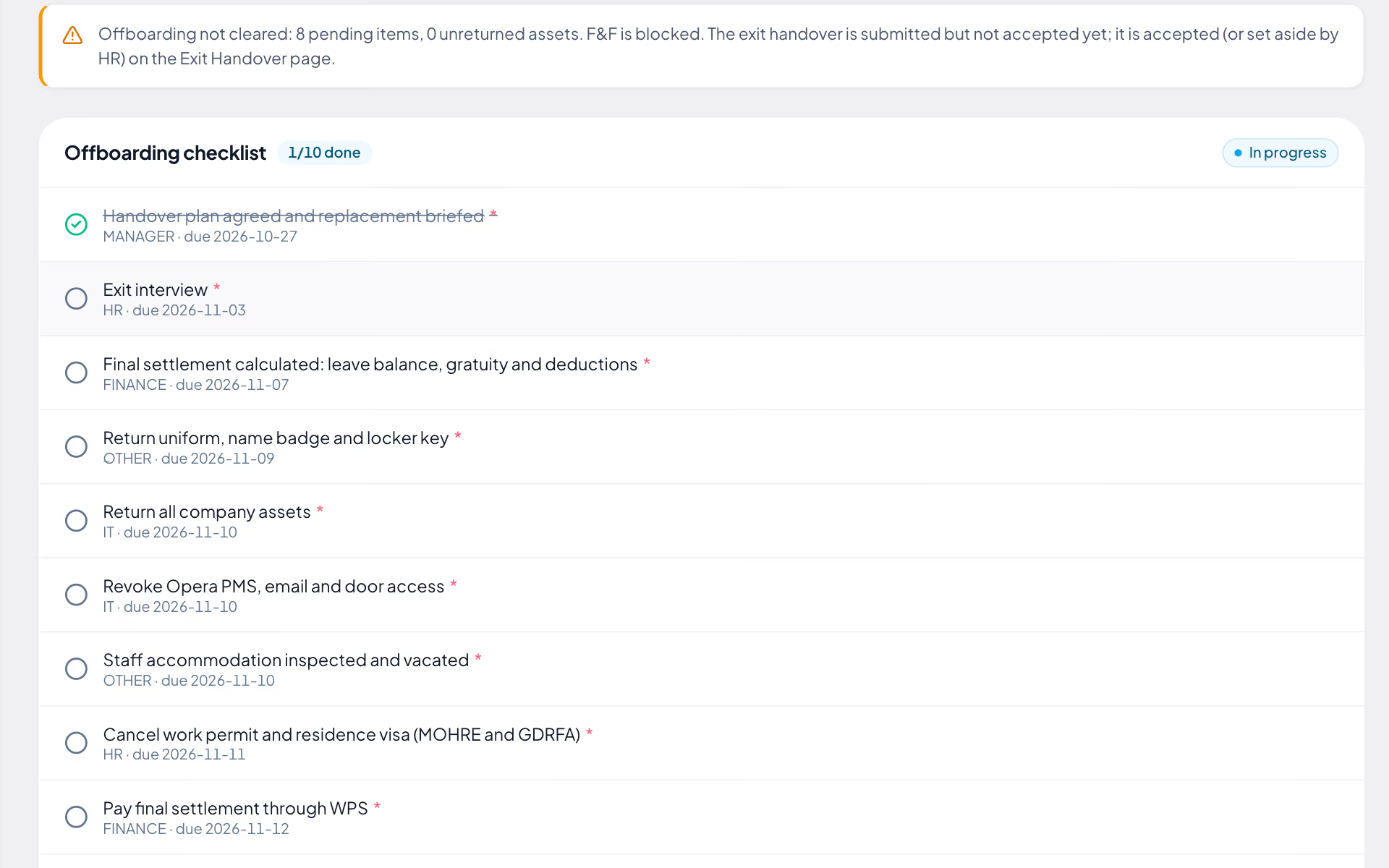
DenwaysHR lets HR raise a termination, redundancy, failed probation or abandonment with a last working day, a reason the employee sees and a notice-waived flag. Nobody approves their own exit, and on plans with payroll the settlement can't be approved while clearance items are open.
See the employee lifecycleSources
- UAE Legislation portal: Federal Decree-Law No. 33 of 2021, current text with its amendments
- UAE Legislation portal: Cabinet Resolution No. 1 of 2022, the Executive Regulation
- UAE Government portal: Terminating employment contracts and arbitrary dismissal
- UAE Government portal: Disciplinary rules and procedures
- UAE Government portal: Labour disputes
- UAE Government portal: Types of leaves
- ADGM rulebook: Employment Regulations 2024, section 56, minimum notice
Official pages, as they stood on the date above. The law is the authority; check it, or ask your adviser, before acting on a figure.
Questions
Ending employment questions.
Can a UAE employer terminate without giving a reason?
Article 43 lets either side end the contract for a legitimate reason with written notice. Keep the reason on file, because a termination that follows a valid complaint or claim is unlawful under Article 47.
Can notice be given while an employee is on annual leave?
Yes, but under Article 35 the notice period starts the day after the employee's scheduled return from leave, unless both sides agree otherwise.
How long does an employee have to bring a claim?
Article 54 of the current law says a case for rights under the law cannot be heard after two years from the end of the employment. The u.ae disputes page still says one year; we follow the law's current text. The claim starts with MOHRE.
Keep reading
Bring your whole workforce onto one platform.
See how DenwaysHR handles HR, attendance and leave across the GCC, and payroll with the WPS file in the UAE.