Employee insurance in the UAE: Four kinds of cover,
and who pays for each.
What UAE employers must provide and who pays: health insurance, worker protection insurance or a bank guarantee, ILOE job loss cover and work injury pay.
The short answer
A UAE employer must provide health insurance for employees, and either a worker protection insurance policy or an AED 3,000 bank guarantee for each worker. It must also treat and compensate work injuries under Article 37 of the labour law. ILOE job loss insurance is compulsory too, but the worker pays that premium. No single policy covers all of these.
Four different duties get called employee insurance in the UAE, and each one has a different payer. Here is who owes what, what it costs on the official figures, and where a company can choose.
What insurance must a UAE employer provide?
Health insurance, worker protection and work injury costs fall on the employer. ILOE job loss insurance falls on the worker.
| Duty | Protects against | Who pays | How it is paid |
|---|---|---|---|
| Health insurance | Medical costs | The employer buys the employee's policy; dependants depend on the emirate | Premium to an insurer; AED 320 a year for the basic package in the northern emirates |
| Worker protection | The employer failing to pay what it owes | The employer | A premium of AED 137.50 to AED 250 per policy for company staff, or an AED 3,000 bank guarantee per worker |
| ILOE job loss insurance | Losing a job involuntarily | The worker | AED 5 or AED 10 a month, by basic salary |
| Work injury | Injury or occupational disease | The employer | Directly: treatment, wages during treatment and compensation |
What is labour insurance in the UAE?
People usually mean the worker protection scheme, which the portal also calls Taa-meen. It exists in case a company goes bankrupt or fails to pay what it owes.
Under Ministerial Resolution No. 318 of 2022, an establishment chooses for each worker between a bank guarantee of at least AED 3,000 and an insurance policy. The guarantee has to come from a bank operating in the UAE, run for a year and renew automatically.
| Policy | Premium per policy |
|---|---|
| Skilled worker | AED 137.50 |
| Low-skilled worker | AED 180 |
| High-risk establishment not complying with WPS | AED 250 |
| Domestic worker | AED 105 |
For 20 skilled workers, the choice looks like this: AED 2,750 in premiums for one policy term, or AED 60,000 held in guarantees that run a year and renew. The term matters when you compare them: the portal says a policy is valid for 30 months, and elsewhere on the same page "a two-year insurance policy" for new hires, so confirm it when you buy. For new hires the employer picks when applying for the work permit. A worker already under a guarantee can move to insurance only when the permit is renewed. The guarantee is refunded on that switch if the company has no salary payment violation in the previous six months.
The policy covers up to AED 20,000 per worker. That includes unpaid wages for up to the last 120 days, end-of-service benefits, repatriation costs and medical costs for work injuries. Health insurance is outside it. And the premium doesn't end the employer's liability: what the insurer pays out, the employer has to repay. If it doesn't, MOHRE suspends its file, freezes new work permits and asks for the AED 3,000 guarantee at renewals.
Who pays for employee health insurance?
The employer buys the employee's policy, and from 1 January 2025 it is a condition of issuing or renewing a private-sector residence permit. Dependants are where the emirates differ. In Abu Dhabi the employer's or sponsor's duty includes one spouse and three children under 18.
In Dubai, sponsors insure their resident dependants. The health insurance guide has the full rules by emirate, the co-payments and what to record.
Is job loss insurance the employer's responsibility?
No. The duty to subscribe and pay sits with the worker, and so does the AED 400 fine for failing to do either.
The employer's role is practical: new joiners ask HR about it, and a claim has to be made within 30 days of the job ending. An employer who wants to cover the premium as a benefit should say so in writing. Our ILOE guide sets out the categories, the payout and who is left out.
What does an employer owe after a work injury?
Article 37 places the cost on the employer. It pays for treatment until the worker recovers or a disability is confirmed, including hospital stays, surgery, medicines and rehabilitation.
While the injury keeps the worker off work, it pays the full wage for up to six months, then half for up to six more. On a wage of AED 6,000, a full year of treatment comes to AED 36,000 plus AED 18,000, or AED 54,000 in wages.
Permanent disability or death brings compensation on top, worked out on basic salary. For death or total disability it is 24 months of basic, from AED 18,000 to AED 200,000. Partial disability is the percentage in the schedules to Cabinet Resolution No. 33 of 2022, multiplied by 24 months of basic, within the same limits.
| Case | Basic salary | Working | Compensation |
|---|---|---|---|
| Death or total disability | AED 5,000 | 5,000 × 24 | AED 120,000 |
| Death or total disability | AED 10,000 | 10,000 × 24 = 240,000, above the limit | AED 200,000 |
| 30% partial disability | AED 5,000 | 30% × 120,000 | AED 36,000 |
| 20% partial disability | AED 2,000 | 20% × 48,000 = 9,600, below the limit | AED 18,000 |
- Report a work injury or occupational illness to MOHRE within 48 hours
- Pay compensation within 10 days of the medical report
- Commuting counts where the worker keeps to the usual route without a break or detour
- Compensation can fall away for a deliberate injury, intoxication, intentional breach of posted safety rules, or refusing examination or treatment
Does a UAE employer need workers' compensation insurance?
The official pages listed below set a duty to pay. None of them names a compulsory workers' compensation policy. A company can still insure the risk, but read the policy against Article 37, because the worker's claim is against the employer.
The worker protection policy only reaches medical costs for work injuries within its AED 20,000 limit, and the employer repays those too.
What does the employer not have to provide?
Four things are often assumed to be the employer's and are not.
- The ILOE premium, which is the worker's to pay
- Cover for an employee's dependants in Dubai, where it falls to the sponsor
- Life or critical illness cover: none of the official pages we read requires it, so treat it as a benefit, and as binding if the contract promises it
- A bank guarantee if it buys the insurance policy, or the other way round
One group needs a separate check. An employer must register an Emirati employee with the pension system within a month of the work permit being issued, and the GPSSA guide covers those contributions.
What should HR keep on file?
When a worker, an insurer or the ministry asks about a duty, the record is how the company shows it was met.
- For each worker: guarantee or insurance, the policy or guarantee reference, and the end date
- Health policy dates beside the residence visa they support
- ILOE status and expiry, with the basic salary that sets the category
- Each injury: when it was reported, the medical report, wages paid during treatment and the date compensation was paid
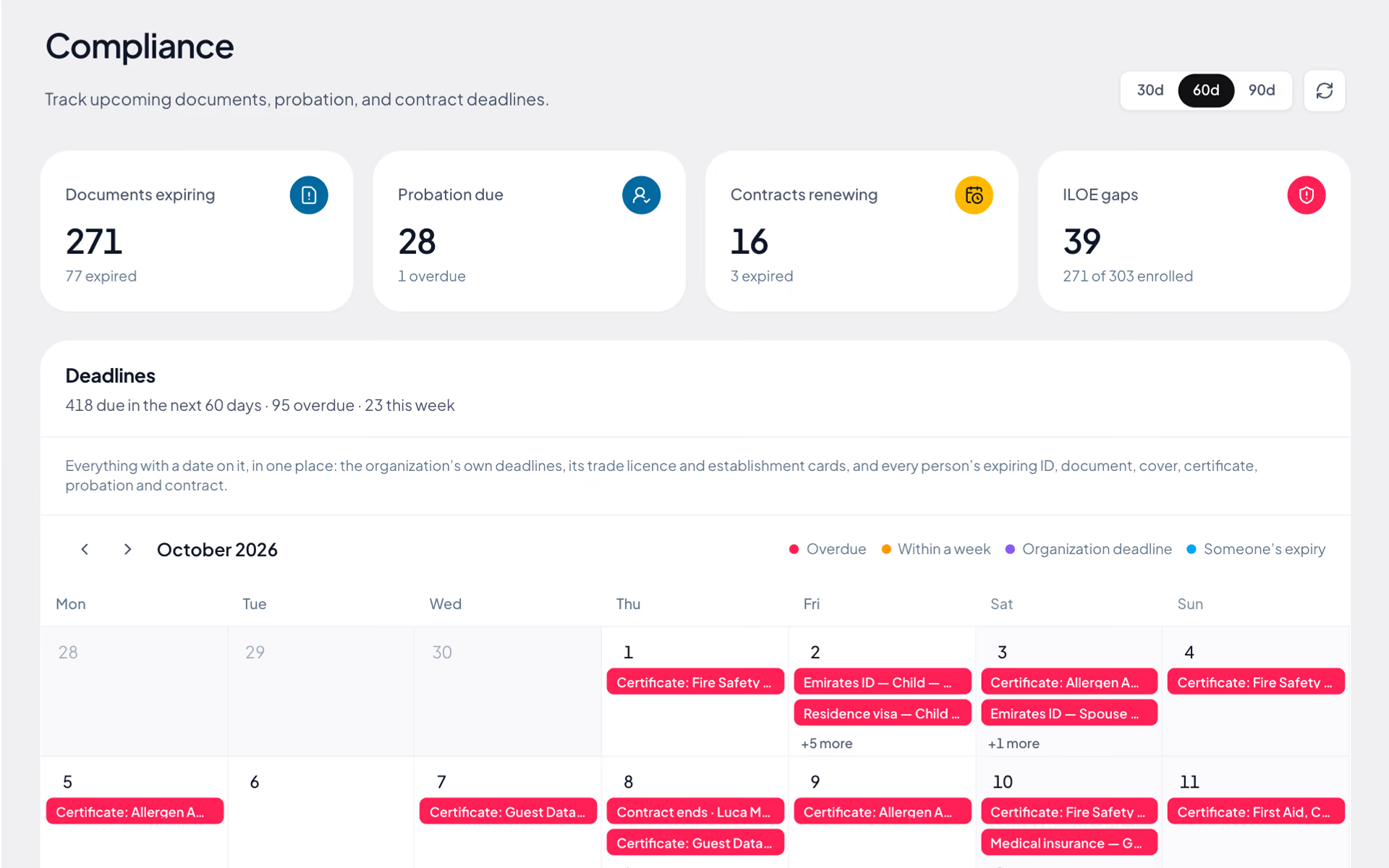
DenwaysHR records each employee's health policy, plan and dependants, warns before a policy ends, and tracks ILOE status and expiry. It reminds; it does not buy cover or pay premiums.
See complianceSources
- UAE Government portal: Insurance against defaulting or non-compliant employers (bank guarantee and worker insurance)
- UAE Government portal: Insurance against job loss
- UAE Government portal: Getting a health insurance
- UAE Government portal: Work injury compensation in the UAE
- UAE Government portal: Health and safety at workplace
- UAE Government portal: Employing Emiratis in the private sector
- UAE Government portal: Federal Decree-Law No. 33 of 2021, English text (PDF, not an official translation)
Official pages, as they stood on the date above. The law is the authority; check it, or ask your adviser, before acting on a figure.
Keep reading
Bring your whole workforce onto one platform.
See how DenwaysHR handles HR, attendance and leave across the GCC, and payroll with the WPS file in the UAE.