UAE labour law changes since 2022: Five years of UAE
labour law, in date order.
Dated UAE labour law changes for HR and payroll since 2022: the new law, ILOE, Emiratisation targets, WPS under Resolution 340 and the Emirati pay floor.
The short answer
Since Federal Decree-Law No. 33 of 2021 took effect on 2 February 2022, employers have taken on ILOE job-loss insurance from 1 January 2023, Emiratisation targets rising two points a year to 10% by the end of 2026, a hiring rule for 20 to 49 staff companies, an AED 6,000 Emirati pay floor from 1 January 2026 and a WPS due date of the 1st under Resolution 340 of 2026.
A handbook or payroll setup written before 2022 is now wrong in several places, and more has changed every year since. This puts each change against its date, with the guide that explains it, so you can see what your own settings have missed.
Which UAE labour law changes since 2022 matter to payroll?
| Date | Change | Who it reaches |
|---|---|---|
| 2 February 2022 | Federal Decree-Law No. 33 of 2021 takes effect: fixed-term contracts only, no gratuity cut on resignation | Every mainland private employer |
| 1 January 2023 | ILOE job-loss insurance subscription opens | Employees, with questions for HR |
| 2023 | Voluntary Savings Scheme created as an alternative to gratuity | Employers that choose to join |
| 31 October 2023 | New GPSSA pension rates for Emiratis first insured from this date | Employers of UAE nationals |
| 2024 | One Emirati hire required in 20 to 49 staff companies in 14 sectors | Companies of 20 to 49 employees |
| 1 January 2025 | Health insurance compulsory in Sharjah and the northern emirates | Employers in those five emirates |
| 1 January 2026 | AED 6,000 minimum monthly salary for Emiratis | Employers of UAE nationals |
| 31 December 2026 | Emiratisation target reaches 10% of skilled roles | Companies of 50 or more employees |
| 2026 | WPS: wages due on the 1st under Ministerial Resolution No. 340 of 2026 | Every employer on WPS |
What changed in 2022?
- 2 February 2022: Federal Decree-Law No. 33 of 2021 took effect, replacing Federal Law No. 8 of 1980. Private-sector contracts now run for a definite term, renewable by agreement, and the unlimited contract was abolished
- 2 February 2022: the old rule that cut gratuity by a third or two thirds when an employee resigned with under five years' service ended. Gratuity is now 21 days' basic salary for each of the first five years and 30 days after, capped at two years' wage (final settlement guide)
- From 2 February 2022: contracts signed as unlimited under the 1980 law had to be converted to fixed terms within a year of the new law's start, and the Minister could extend that period. We have not found MOHRE's own page confirming any later date (contract types guide)
- 2022: Cabinet Resolution No. 1 of 2022, the Executive Regulation, set the rules that apply the law, including the two-hour shorter working day in Ramadan
- 2022: Federal Decree-Law No. 13 of 2022 created ILOE, the compulsory unemployment insurance scheme
- 2022: Cabinet Resolution No. 95 of 2022 set the penalties for fake Emiratisation and for abusing Nafis support (Emiratisation guide)
What changed in 2023?
- 1 January 2023: subscription to ILOE opened. The employee pays AED 5 a month on a basic salary of AED 16,000 or less and AED 10 above it, and the fine for not subscribing is AED 400 (ILOE guide)
- 2023: Federal Decree-Law No. 20 of 2023 amended Federal Decree-Law No. 33 of 2021. The UAE Government portal now names the two together as the UAE labour law (labour law for HR)
- 2023: Cabinet Resolution No. 96 of 2023 created the voluntary Savings Scheme. An employer that joins pays 5.83 per cent of monthly basic salary for an employee with under five years' service and 8.33 per cent after, in place of building up gratuity (salary structure guide)
- 31 October 2023: Emiratis first insured on or after this date contribute to GPSSA under Federal Decree-Law No. 57 of 2023, at 11 per cent from the employee and 15 per cent from the employer, or 12.5 per cent where the government pays 2.5. Those insured before stay under the 1999 law, at 5 and 12.5 per cent
- 2023: Cabinet Resolution No. 44 of 2023 added penalties for avoiding the Emiratisation target by cutting the workforce or reclassifying employees (Emiratisation guide)
- 2023: Ministerial Resolution No. 455 of 2023 set out the Emiratisation rule for companies with 20 to 49 employees in selected sectors, which applies from 2024 (Emiratisation guide)
- 2023: Ministerial Resolution No. 240 of 2023 created a national student contract: full-time, at least AED 4,000 a month, counted towards Emiratisation (contract types guide)
What changed in 2024?
- 2024: companies with 20 to 49 employees in 14 listed sectors had to hire at least one UAE national by the end of the year (Emiratisation guide)
- 2024: companies with 50 or more employees had to reach 5 per cent of skilled roles held by UAE nationals by 30 June and 6 per cent by 31 December, with a shortfall charged at AED 8,000 a month for each unfilled position (Emiratisation guide)
- 2024: amendments to the labour law let MOHRE decide claims of up to AED 50,000 itself, with its decision enforceable like a judgment, and give an employee two years from the end of employment to bring a claim (final settlement guide)
Check your Emirati share of skilled roles against this year's checkpoint.
Open the Emiratisation calculatorWhat changed in 2025?
- 1 January 2025: private employers in Sharjah, Ajman, Ras Al Khaimah, Umm Al Quwain and Fujairah had to insure their employees, with a basic package at AED 320 a year. Cover became a condition of issuing or renewing a residence permit (health insurance guide)
- January 2025: a company of 20 to 49 employees that did not hire an Emirati in 2024 owed AED 96,000 (Emiratisation guide)
- 2025: the targets for companies of 50 or more rose to 7 per cent by 30 June and 8 per cent by 31 December, and the monthly contribution to AED 9,000 a position (Emiratisation guide)
- 2025: companies of 20 to 49 employees in the listed sectors had to hire a second UAE national by the end of the year (Emiratisation guide)
- 1 April 2025: the ADGM Employment Regulations 2024 took effect in Abu Dhabi Global Market, replacing the 2019 regulations (DIFC and ADGM guide)
- 15 July 2025: DIFC Law No. 1 of 2025 amended the DIFC Employment Law. DIFC employers have paid monthly DEWS contributions in place of gratuity since 2020 (DIFC and ADGM guide)
What has changed in 2026?
- 1 January 2026: an Emirati in the private sector must be paid at least AED 6,000 a month. Our Emiratisation guide records that the ministry applies it when a work permit is issued, renewed or amended, and gave employers until 30 June 2026 for Emiratis already employed
- January 2026: a company of 20 to 49 employees that did not hire two Emiratis in 2025 owed AED 108,000. The portal page we read sets no step after 2025 (Emiratisation guide)
- 2026: the targets reach 9 per cent of skilled roles by 30 June and 10 per cent by 31 December. On the same AED 1,000 yearly rise the contribution is AED 10,000 a month per position, though the totals we could read stop at 2025, so confirm the 2026 figure with MOHRE (Emiratisation guide)
- 2026: Ministerial Resolution No. 340 of 2026 made a month's wages due on the first day of the next month through the Wage Protection System, with at least 85 per cent of total wages transferred on time. Our WPS guide dates it to 1 June 2026; the UAE Government portal names the resolution but not its start date
- 2026: the same resolution set a day-by-day timetable after the due date: alerts from the 2nd day, new work permits stopped on the 5th, fines for repeat cases on the 11th and automatic labour disputes from the 16th (late salary guide)
Where we have kept a question open
We could not open the text of Resolution 340 or MOHRE's site, so the 1 June 2026 start, the 30 June 2026 deadline for existing Emirati salaries and the AED 10,000 contribution for 2026 are as our other guides record them, not confirmed on the UAE Government portal. Check them with MOHRE before relying on them.
What should HR check against this timeline?
- Contract templates: a fixed term, renewable by agreement, and no unlimited contracts left from before 2022
- Gratuity settings: no reduction for resignation, and the Savings Scheme instead of gratuity for anyone enrolled in it
- Pension: each Emirati on the right GPSSA rate for the date they were first insured
- Emiratisation: the count of skilled roles against the June and December checkpoints, and every Emirati at AED 6,000 a month or more
- Payroll calendar: approval early enough that wages reach employees by the 1st of the following month
- Health insurance: cover in place before each residence permit renewal in Sharjah and the northern emirates
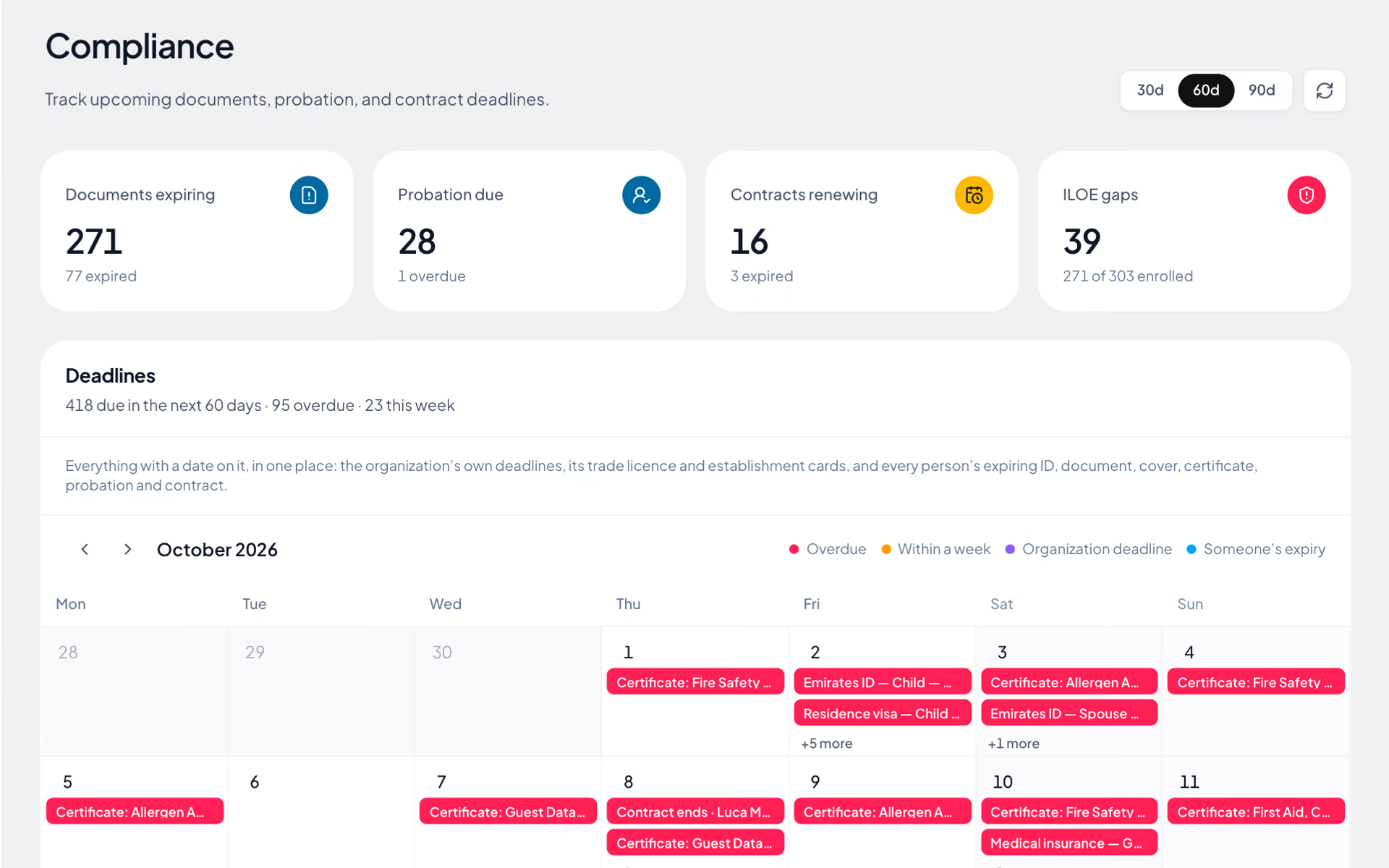
DenwaysHR shows your Emirati share of skilled roles against the next checkpoint and tracks each employee's ILOE status and policy expiry. It counts skill levels 1 to 3 as skilled, which is not the portal's test, so check its figure. It tracks and reminds; it does not file anything with MOHRE.
See the compliance dashboardSources
- UAE Government portal: Employment laws and regulations in the private sector (Federal Decree-Law No. 33 of 2021, in force 2 February 2022)
- UAE Government portal: Employing Emiratis in the private sector (targets, the 20 to 49 rule, the AED 6,000 minimum)
- UAE Government portal: Insurance against job loss (Federal Decree-Law No. 13 of 2022)
- Emirates News Agency (WAM): Subscription to the Unemployment Insurance Scheme starts on 1 January 2023
- UAE Government portal: Payment of salaries and wages (Ministerial Resolution No. 340 of 2026)
Read on 2 November 2026. Entries that rest on another page, such as the pension rates, health insurance and the free zone laws, take their facts from the linked guide, which lists its own sources.
Questions
Labour law change questions.
When did the new UAE labour law take effect?
Federal Decree-Law No. 33 of 2021 took effect on 2 February 2022, replacing Federal Law No. 8 of 1980. The UAE Government portal names Federal Decree-Law No. 20 of 2023 as an amendment to it.
Do the Emiratisation targets rise after 2026?
The UAE Government portal describes the targets as rising two percentage points a year to reach 10 per cent by 2026, and we found no published step beyond that. Check with MOHRE before planning for 2027.
Is there a minimum wage in the UAE private sector?
The UAE Government portal says the labour law sets no general minimum salary. The exception is UAE nationals: since 1 January 2026 an Emirati in the private sector must be paid at least AED 6,000 a month.
Keep reading
Bring your whole workforce onto one platform.
See how DenwaysHR handles HR, attendance and leave across the GCC, and payroll with the WPS file in the UAE.